


Good Thursday AM from your Hometown Lender. Here’s today’s market analysis.
Yesterday was just a bad day for the bond market. After watching mortgage bonds start out with big losses on Friday, Monday, and Tuesday but recover each day, yesterday broke the pattern. Bonds started the day with a bit of gains (net the bond rollover) but just got worse and worse through the day as news came in about tankers being attacked in the Gulf and Strait of Hormuz and oil prices kept rising.
Today, markets are waking up to the fact that the conflict in the Middle East is creating the biggest-ever disruptions in oil markets, affecting 7.5% of global supply and even an even greater portion of exports according to Bloomberg. Brent crude oil is teetering right below $100 a barrel again, and despite assurances otherwise, this conflict is ongoing.
Rates today are worse, reflecting yesterday’s big losses, with bonds picking up where they left off and worsening on the day. Reprice risk is high, we could see oil prices continue higher and more headlines about escalating attacks.
Market Analysis – From a higher and better view;
Market Analysis – Quick Snapshot
- 10-year Treasury: ~4.24% (up vs. last week; that’s why rate sheets feel less friendly).
- Oil: Brent briefly above $100 as Middle East tensions intensify; markets are pricing an inflation “uh-oh.”
- Mortgage rates (Freddie Mac weekly): 30-yr 6.11% (up from 6.00% last week); 15-yr 5.50%.
- Consumer-facing average (Bankrate/WSJ): 30-yr ~6.23%, 15-yr ~5.56%.
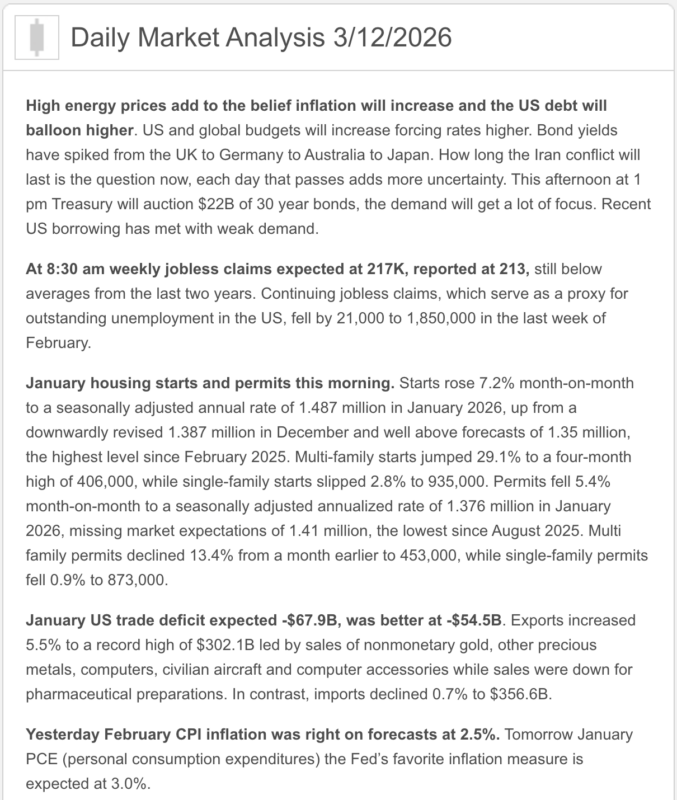
- Labor (weekly jobless claims): 213,000 (still “stable labor market” territory).
- Inflation (Feb CPI, released yesterday): +0.3% MoM / +2.4% YoY; Core +0.2% MoM / +2.5% YoY.
- Fed funds target range: 3.50%–3.75%; next meeting Mar 17–18.
1) Market Analysis – What Hit This Morning (CPI)
No CPI this morning—today was “current events + labor + housing starts.”
A) Jobless Claims
- Initial claims: 213K (down slightly).
- Continuing claims: around 1.85M (still consistent with a job market that’s bending, not snapping).
B) Housing Starts (January data)
- Single-family starts: 935K SAAR (-2.8%).
- Total starts: 1.487M SAAR (+7.2%, helped by multifamily).
- Total permits: 1.376M (-5.4%).
C) The headline that’s bullying everything else
- Oil + Middle East escalation (tanker attacks / Hormuz threats / supply disruption talk) has markets pricing higher inflation risk, even as growth data cools.
Narrative you can use:
“Today’s data says the economy is still functioning. Today’s headlines say the energy market is not in a cooperative mood. Bonds listen to both… and mortgage rates get the memo.”
2) Fed Watch
- Policy rate remains 3.50%–3.75%.
- Next FOMC: March 17–18 (SEP meeting).
- The Fed’s dilemma: yesterday’s CPI was “fine,” but an oil shock can re-ignite inflation expectations fast, which is how rate cuts get delayed in the real world.
3) Market Analysis – Where Mortgage Rates Actually Are
- Freddie Mac weekly average: 6.11% (30-yr), 5.50% (15-yr).
- Daily consumer averages: roughly 6.23% (30-yr) via Bankrate/WSJ.
- Why rates aren’t celebrating CPI: markets are treating inflation as “contained,” but energy/geopolitics as “uncontained.”
4) Market Analysis – Housing Market Check
Transactions / demand
- Existing-home sales (Feb): 4.09M SAAR (+1.7% MoM, -1.4% YoY).
Supply
- Inventory: 1.29M units (3.8 months supply).
- Realtor.com: active listings +7.9% YoY, median list price $403,450 (-2.1% YoY), and homes took ~4 days longer than a year ago.
New construction
- Single-family starts and permits weakened in January (weather + broader constraints), while multifamily carried the headline.
5) Political Backdrop & Fed Independence
Two “current events” lanes matter for housing/rates today:
A) War → Oil → Inflation expectations
- IEA called the situation the largest oil supply disruption (and agreed to a record strategic release). Markets are still nervous it won’t be enough.
- Goldman raised oil forecasts and warned that prolonged Hormuz disruption could keep pressure elevated.
B) Washington housing policy (rare bipartisan moment)
- The Senate advanced a bill aimed at speeding/cheapening housing construction, modernizing factory-built housing rules, and restricting very large investors from buying more single-family homes (with some industry pushback on investor provisions).
(Translation: markets are trying to price mortgages while the news cycle is doing parkour.)
6) Market Analysis – What This All Means for Rates Going Forward
| Scenario | What has to happen | Rate impact |
| 1) Oil stabilizes (best case) | Energy calms, CPI stays tame, risk premium fades | 10-yr drifts lower → mortgage pricing improves |
| 2) Base case: headline chop | CPI fine, but geopolitics keeps injecting inflation risk | Range-bound rates; good lock windows appear briefly |
| 3) Oil stays hot (negative) | Supply disruption persists, inflation expectations rise | 10-yr stays firm → mortgages resist falling (or pop higher) |
7) Practical Takeaways
- Buyers: More listings than last year in many markets + slightly softer asking prices is real… but payment sensitivity is still the boss.
- Sellers: Not 2021. Not 2008. Proper pricing + condition wins; “let’s try $100K over because feelings” loses.
- Pros: Today’s jobless claims say the consumer isn’t falling apart.
8) Lock vs Float
- 30–60+ days out: Float with rules. If the energy premium fades, rates can improve quickly—but float with a plan, not a prayer.
- Closing in 7–21 days: Lock-leaning. When oil headlines are moving yields, lenders can reprice for the worse fast.

Stay safe and make today great!