


Good morning on this best day of the week Wednesday from your Hometown Lender. Here is Wednesday’s market analysis!
After a weak start that pushed rates higher, yesterday was a calm day basically as expected. The 10yr ended the day at 4.35, the highest we’ve seen since March, and was poised to move higher. Rates today are worse as bonds started the day with losses and are sinking further. This is likely a bear steepening before the Fed meeting concludes in about 3 hours.
The Fed will release it’s policy statement at 11am today, and it is already a given that there won’t be any changes to its policy rate. There are usually very little changes in the Fed’s statement from meeting to meeting, one thing that traders will be looking for though is if there is any change in the language that would imply rate cuts are off the table. A nine-word phrase that suggests the next move is more likely to be a cut than a hike has been in the statement since late last year. If that language disappears this time, it will imply a rate hike is just as likely the next move as a rate cut. Other than that, happening, we shouldn’t see much movement when the statement comes out.
The real fun will begin when Fed Chair Powell holds his press conference a half hour later. Expect markets to react to Powell’s prepared comments, and then his answer to questions. The presser usually lasts about an hour, and we usually see bonds make the biggest moves around the 45-minute mark. We can count on questions about Powell stepping down, the DOJ probe that has been “dropped” but referred to the Office of Inspector General and could be reopened, and inflation from higher gas and energy prices. I don’t think that there are many scenarios where we see Powell’s press conference help rate sheets today.
It’s likely we end the day with worse pricing than we started.
Market Analysis -From a higher and better view:
Market Analysis –Quick Snapshot
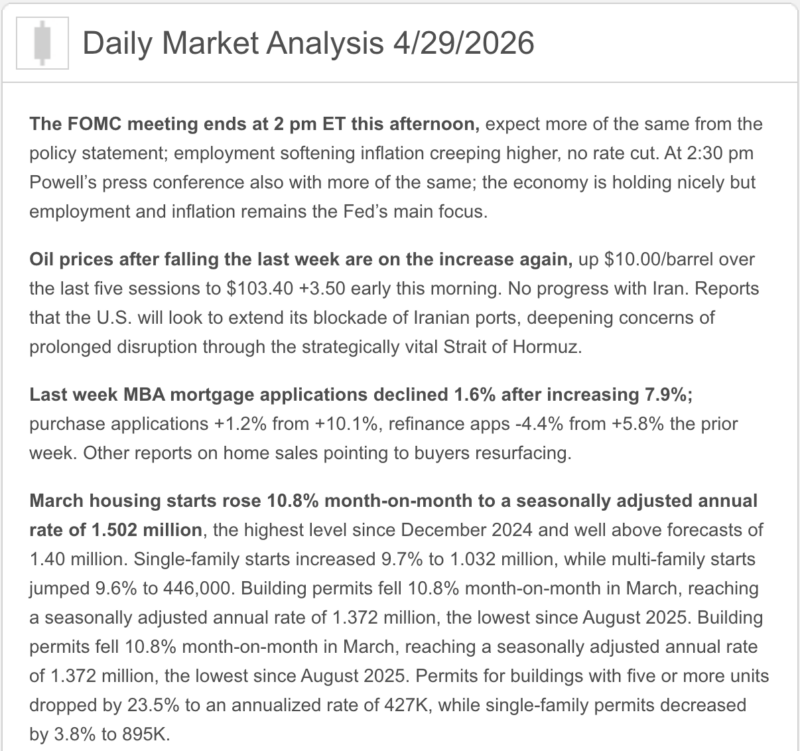
- Today is Fed day, but oil is still trying to be the main character. Brent hit about $115.50 and WTI about $103.96 after reports the U.S. may extend the blockade of Iranian ports, while the 10-year Treasury yield was around 4.36%. U.S. stocks opened lower ahead of the Fed and Big Tech earnings, with the Dow down 0.56%, the S&P 500 down 0.18%, and the Nasdaq down 0.17%.
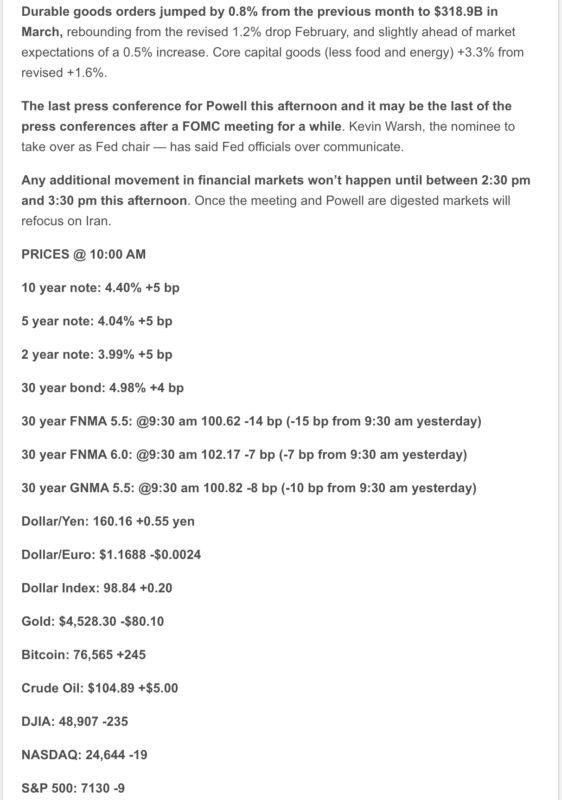
- This morning’s domestic data was stronger than they looked at first glance. The goods trade deficit widened 5.3% to $87.9 billion in March, which is a drag on Q1 GDP, but core capital goods orders jumped 3.3%, their biggest gain since June 2020, and shipments rose 1.2%, which helps the business-investment story. Wholesale inventories rose 1.4% and retail inventories rose 0.7%.
- Housing sent a mixed signal. Single-family housing starts jumped 9.7% in March to a 13-month high of 1.032 million, but single-family permits fell 3.8%, suggesting builders still do not trust the road ahead. FHFA also said national home prices were flat month over month in February and up 1.7% year over year.
- The Fed is still in a 3.50% to 3.75% target range, and no change is expected this afternoon. Reuters reports the decision is due at 2:00 p.m. EDT with Powell speaking at 2:30 p.m. EDT, and this may be his last meeting as chair.
- Mortgage rates look better in the weekly survey, but a little worse in the more current application data. Freddie Mac’s latest weekly survey still shows the 30-year fixed at 6.23% and the 15-year fixed at 5.58%, while today’s MBA data showed the average 30-year contract rate ticked up to 6.37%, total applications fell 1.6%, refis fell 4%, and purchase apps rose 2%.
1) Market Analysis -What Hit This Morning
The biggest pure economic surprise this morning was business investment. Core capital goods orders rose 3.3% in March, far above expectations, and shipments rose 1.2%, which suggests equipment spending gave Q1 growth a helpful shove. Durable goods orders overall rose 0.8%. That is a real positive for the economy, even if some of it may reflect higher prices and AI/data-center spending rather than broad-based confidence.
The offset is trade. The March goods deficit widened to $87.9 billion as imports rose sharply, especially motor vehicles, and that is likely to weigh on tomorrow’s GDP report. Inventories rose enough to soften some of that hit, but not erase it. So the morning data basically said: business investment looks better, trade looks worse, and GDP is going to need a little help from inventories and equipment spending to keep its footing.
Narrative you can use:
“Today’s U.S. data were better under the hood than the headline trade number suggests. Business investment looked strong, housing starts improved, and inventories rose, but the bond market is still paying more attention to $115 oil than to any one decent domestic report.”
2) Fed Watch
Officially, the Fed is still at 3.50% to 3.75%, and markets are overwhelmingly expecting a hold this afternoon. Reuters says policymakers are weighing whether to more clearly flag inflation risks from higher oil prices, and the meeting could be the last one chaired by Jerome Powell.
The politics around the Fed are no longer background noise. Kevin Warsh cleared the Senate Banking Committee 13-11 on Wednesday, opening the way for a full Senate vote as early as the week of May 11; if that happens, he could be sworn in by May 15, when Powell’s chair term ends. Reuters also notes Powell’s Board seat runs until January 2028, so one of the big side questions today is whether he signals any intention to stay on as a governor.
The rate-path issue is still stubborn. Reuters reports traders see little chance of a cut before the middle of next year, because high oil prices and still-elevated inflation are making the Fed more cautious, not less. That is not exactly a coupon for lower mortgage rates arriving tomorrow morning.
3) Market Analysis -Where Mortgage Rates Actually Are
The good-news version is Freddie Mac: the 30-year fixed at 6.23% and the 15-year fixed at 5.58%, with the 30-year at its lowest level of the last three spring homebuying seasons. That is real improvement from the early-April spike.
The more real-time version is MBA, and it is a little less cheerful. The average 30-year contract rate rose to 6.37% for the week ended April 24, total applications fell 1.6%, refis dropped 4%, and purchases rose 2%. That says buyers are still out there, but the market is not exactly gliding. More determined shuffle than moonwalk.
The bigger truth is still the same: mortgage pricing is being pushed around more by oil, inflation expectations, and Treasury yields than by hope for Fed cuts. Today’s jump in crude is not exactly a love letter to bond bulls.
4) Market Analysis -Housing Market Check
Today’s fresh housing read was actually decent on the starts side. Single-family starts rose 9.7% to 1.032 million, the highest since February 2025, and overall starts rose 10.8% to 1.502 million. That is the upbeat part. The more cautious part is that single-family permits fell 3.8% and overall permits fell 10.8%, which says builders still see rough weather ahead.
FHFA added a second signal: home prices were flat month over month in February and up 1.7% year over year. That is a slower national pace than the market got used to, but it is still not a world where affordability suddenly sends everyone a fruit basket.
The broader housing backdrop is still mixed. Pending home sales rose 1.5% in March, but existing-home sales fell 3.6% to 3.98 million, inventory rose to 1.36 million, and supply climbed to 4.1 months. Translation: housing is still moving, but not gracefully.
5) Market Analysis -Political Backdrop & Fed Independence
The macro story is still Iran, Hormuz, and energy. Reuters reports oil surged after the Wall Street Journal said the U.S. may extend the blockade of Iranian ports, prolonging supply disruptions. Brent hit a one-month high around $115.50, and WTI hit about $103.96. That is why the inflation story still feels sticky even when some domestic data look better.
The Fed-independence story is now live, not theoretical. Warsh’s committee vote moved the Powell-to-Warsh transition closer, but Democrats are openly questioning whether Warsh can remain independent from White House pressure for lower rates. Markets are not just pricing today’s Fed anymore. They are also pricing what the next Fed might look like.
6) Market Analysis -What This All Means for Rates Going Forward
Base case: mortgage rates stay choppy and vulnerable. Today’s domestic data were not bad, but oil back above $115 Brent is the louder signal, and the Fed is likely to stay cautious this afternoon.
Better case for rates: if diplomacy restarts in a credible way, oil backs off, and tomorrow’s GDP / PCE / ECI data do not show broad inflation re-acceleration, mortgage pricing could hold onto some of its recent improvement. That is an inference, but it is grounded in how tightly rates have been trading off oil and inflation expectations.
Worse case for rates: if oil stays elevated, the Fed leans more hawkish than expected, and tomorrow’s data show hotter inflation or stronger growth than bonds want, the market can give back the recent mortgage-rate improvement pretty quickly.
Tomorrow’s biggest market analysis checkpoints are all at 8:30 a.m. EDT on Thursday, April 30: Q1 GDP advance, March Personal Income and Outlays, and Q1 Employment Cost Index.
7) Practical Takeaways
For buyers, this is still a market where structure beats hope. The weekly Freddie rate is better, but not low enough to make payment sensitivity disappear, and today’s oil move is a reminder that relief can vanish quickly.
For agents, today’s message is balanced: starts improved, home prices were flat month to month, and purchase apps even nudged higher, but permits, sentiment, and energy costs all say this market still needs careful coaching.
For refi and move-up conversations, the honest message is still not “rates are about to tumble.” The smarter message is that windows may open, but they are still being driven more by oil and bond sentiment than by any clean Fed pivot.
8) Lock vs Float
0–15 days from closing: I would still lean lock. Fed day plus hot oil is not a setup where I’d go looking for extra adventure.
15–30 days: this is still case by case. If the borrower is tight on DTI or very payment-sensitive, I’d favor protection. If they have room, today’s Fed and tomorrow’s GDP / PCE / ECI cluster are real volatility checkpoints worth watching.
30+ days: a cautious float can make sense, but only with discipline. Right now the market is trading oil, Fed succession, and incoming inflation data all at once.
Stay safe and make today great!