


Good Thursday morning from your Hometown Lender. Here is today’s market analysis!
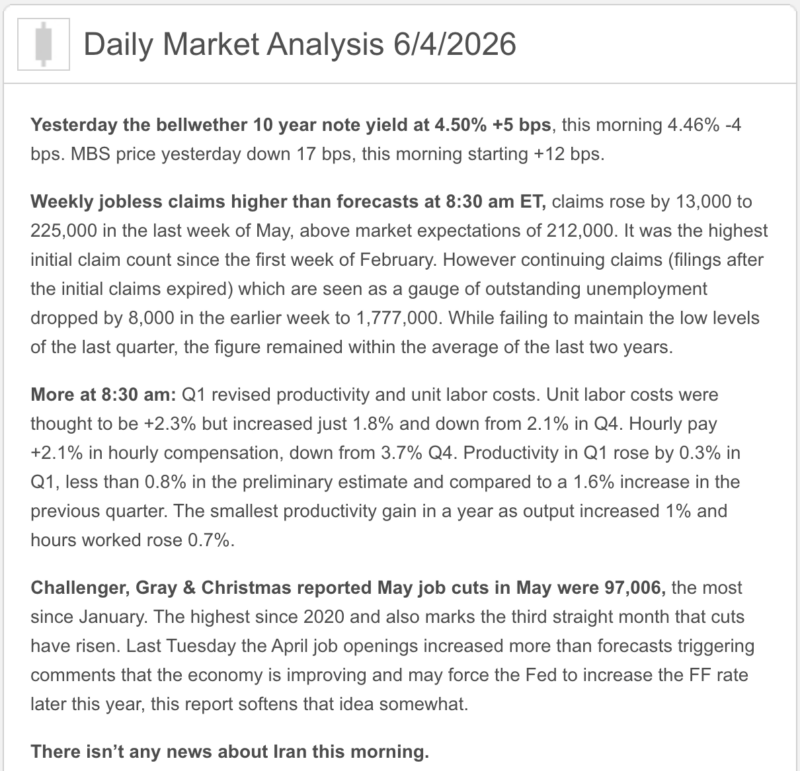
Yesterday saw early movement for bonds, with mortgage bonds selling off early, recovering a bit around 10am ET, but then falling back and ending the day worse. The JOLTS data showed that job openings surged to a two-year-high, but the hiring rate slipped.
The takeaway here is that there wasn’t enough labor market weakness to support changing the outlook on possible Fed rate hikes later this year. The Fed’s Beige Book showed steady employment and higher inflation, also supporting a Fed rate hike.
Bonds are rallying to start the day, which should open the door for better pricing (more like what we saw last Friday) if the gains can hold. Iran said there’s been no real progress in talks on an interim peace deal, even as both sides continue negotiations, according to Iran’s Tasnim news agency. The two countries are still trying to finalize a deal that would extend the current truce by two months and reopen the Strait of Hormuz to commercial shipping.
This second part is the key to seeing oil prices drop and rates improve.
Despite the fighting that is still happening, both Washington and Tehran say talks are ongoing and have signaled they want to reach an agreement. The question is, when will we actually see a deal, and how much will markets react? Could it happen today?
Market Analysis – From a higher and better view:
Market Analysis – Quick Snapshot
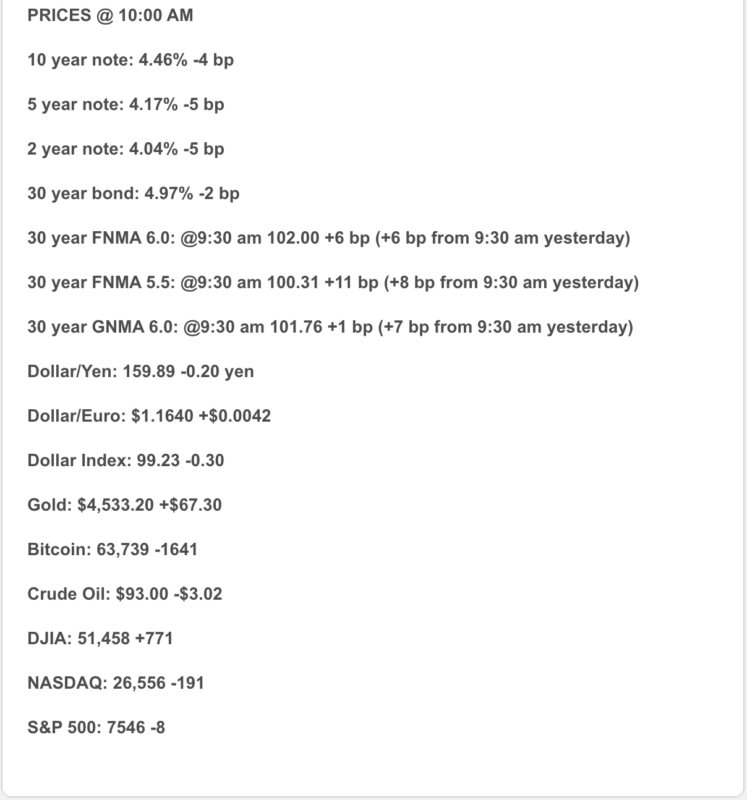
Bonds: The 10-year Treasury is near 4.46%, down slightly as oil prices fell and markets reacted to improving ceasefire headlines in the Middle East. Bonds got a little relief today — not a vacation, but maybe a half-day Friday.
Mortgage Rates: Daily Bankrate/WSJ tracking shows the 30-year fixed around 6.52% and the 15-year fixed around 5.89% today. Freddie Mac’s latest posted weekly PMMS still shows the 30-year fixed at 6.53% and the 15-year fixed at 5.87% as of May 28.
Labor: Initial jobless claims rose to 225,000, up 13,000 from the prior revised week and the highest level since early February. Continuing claims fell to 1.777 million, so the labor market is softer around the edges, but not cracking.
Productivity / Labor Costs: Q1 productivity was revised down to 0.3% annualized, but unit labor costs were also revised lower to 1.8%. Translation: weaker productivity is not ideal, but lower labor-cost pressure helps the inflation story a little.
Inflation / Fed: The Fed’s Beige Book showed prices rising at a moderate to strong pace, with energy costs tied to the Middle East conflict spilling into shipping, packaging, groceries, and fertilizer. That keeps the Fed cautious.
1) Market Analysis – What Hit This Morning
Today’s main data point was jobless claims, which rose more than expected to 225,000. That is not recessionary by itself, but it does support the idea that the labor market is moving further into a “low-hire, low-fire” environment — fewer big layoffs, but also not a lot of aggressive hiring.
The other important release was the revised productivity report. Q1 productivity was marked down to 0.3%, but unit labor costs were revised lower to 1.8%, which helps calm some wage-inflation concern.
Narrative you can use:
The labor market is stable but cooling, inflation is still sticky, and oil/geopolitical headlines are still driving bond volatility. That combination keeps mortgage rates choppy and keeps financing strategy front and center.
2) Market Analysis – Fed Watch
The Fed’s current target range remains 3.50% to 3.75%. The last FOMC statement emphasized that the Committee is watching labor conditions, inflation pressures, inflation expectations, and international developments before deciding its next move.
The Beige Book gave the Fed a tricky setup: modest growth, signs of consumer strain, and higher inflation pressure driven by energy costs. Reuters also noted that Fed officials are increasingly focused on whether inflation risk could require tighter policy rather than easier policy.
Bottom line:
The Fed is not ready to cut. The market wants relief, but the Fed wants proof. Apparently, “please” is not a monetary policy tool.
3) Market Analysis – Where Mortgage Rates Actually Are
Daily mortgage tracking shows the 30-year fixed around 6.52%, roughly unchanged from yesterday, and the 15-year fixed around 5.89%. Freddie Mac’s latest posted weekly survey showed 6.53% for the 30-year fixed and 5.87% for the 15-year fixed.
Practical read:
Rates are workable, but not forgiving. The right conversation is not simply:
“What is the rate?”
It is:
What is the payment? What credits are available? Is a buydown smart? Does an ARM make sense? What is the refinance path if the market improves?
That is where smart deals are getting built right now.
4) Market Analysis – Housing Market Check
Housing remains a payment-sensitive market. Buyers are still active when price, inventory, and monthly payment line up, but higher rates continue to limit urgency.
What this means:
Sellers and builders who help solve the payment problem — through credits, buydowns, incentives, or realistic pricing — are more likely to convert interest into contracts. Buyers have opportunity, but they need structure, not wishful thinking and a calculator.
5) Political Backdrop & Fed Independence
The political and geopolitical backdrop remains a major rate driver. Oil fell about 3% today after an Israel-Lebanon ceasefire lifted hopes for a broader regional deal and a possible reopening of the Strait of Hormuz. Brent was around $95.19, and WTI was around $92.75 in Reuters’ midday report.
That matters because lower oil can help inflation expectations, which can help Treasury yields, which can eventually help mortgage rates. But the word eventually is doing a lot of work there. Negotiations remain fragile, and the Fed is not going to cut rates because of one better oil headline.
Translation:
Mortgage rates are not just following housing data. They are following oil, inflation, labor, Treasury demand, Fed credibility, global conflict, and consumer resilience. A rate sheet now apparently needs a passport and a geopolitical risk desk.
6) Market Analysis – What This All Means for Rates Going Forward
| Scenario | What Needs to Happen | Likely Rate Impact |
| Best Case | Oil keeps falling, Friday’s jobs report softens gently, inflation expectations settle | Mortgage rates drift lower |
| Base Case | Labor cools slowly, inflation stays sticky, Fed stays cautious | Rates remain choppy in the mid-to-upper 6s |
| Risk Case | Oil spikes again, inflation expectations rise, Fed officials lean more hawkish | Rates push higher and reprice risk increases |
My read: base case remains choppy, not catastrophic. Today’s bond tone is better, but tomorrow’s jobs report is the bigger market test.
7) Practical Takeaways
For buyers:
Do not wait for the perfect rate. Perfect rates are like perfect inspection reports — beautiful, rare, and usually followed by fine print. Focus on payment, seller credits, buydowns, program fit, and long-term flexibility.
For homeowners:
Refinance decisions remain case-by-case. Cash-out, debt consolidation, HELOC alternatives, ARM reset planning, and future refinance strategy should all be reviewed individually.
For agents:
This is a payment strategy market. The strongest agents are not just saying, “rates are high.” They are showing buyers how credits, buydowns, price negotiation, and loan structure change the monthly payment.
8) Lock vs Float
- Lock bias: If closing within 30 days, the borrower is payment-sensitive, or the file is tight on ratios, locking remains the cleaner recommendation.
- Float bias: Floating can make sense only with more time, stronger borrower flexibility, and a defined trigger. Today’s bond tone is better, but tomorrow’s jobs report can move the market quickly.
Today’s guidance:
Bias toward locking short-term closings. For longer timelines, cautious floating may be reasonable only if the borrower understands the risk and has a clear ceiling for pain. Floating without a plan is not strategy
Stay safe and make today great!