


Good Thursday morning from your Hometown Lender. Let’s dive into the post-FOMC market analysis!
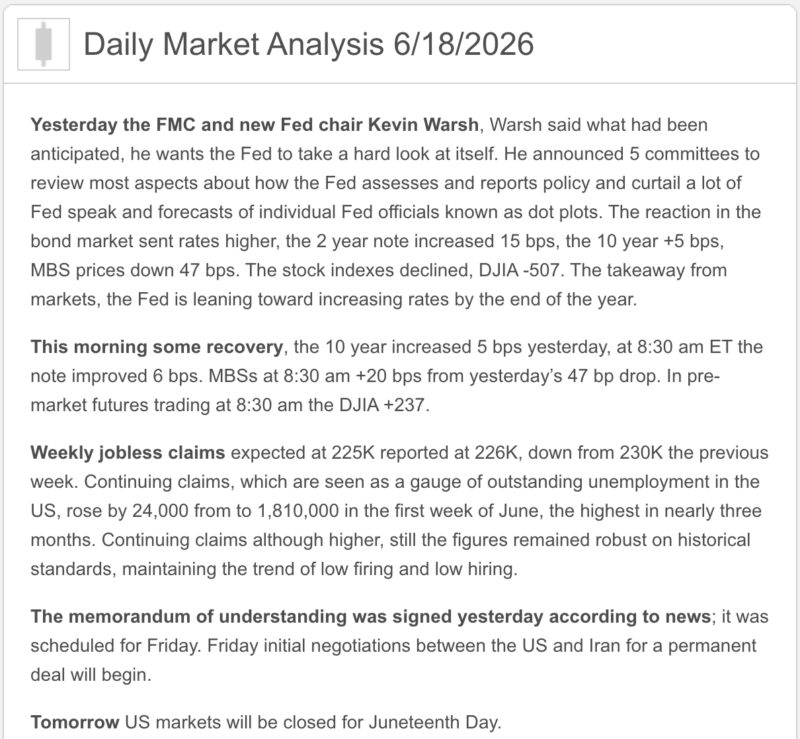
Yesterday showed that Fed Chair Kevin Warsh does not seem to be the pushover puppet of President Trump that he was accused of being. Things started to get bad for bonds with the release of the much shorter Fed policy statement and the dot plot. The dot plot showed that nine Fed members think there will be at least one rate hike this year, with six of them thinking it could be more.
Markets expected Chairman Warsh would have a more dovish message in his press conference to push back against the idea of rate hikes (by the way, Warsh didn’t post any projections on this dot plot). The focus was/is clearly on taming inflation (with no mention of the Fed’s second mandate, employment). This caused mortgage bonds to keep selling. Today, bonds are worse than yesterday before the Fed meeting, but the recovery this morning was enough to gain back more than half the losses. Markets are closed tomorrow for Juneteenth.
Market Analysis – From a higher and better view:
- Bonds: The 10-year Treasury is around the mid-4.4% range, helped by lower oil prices after the U.S.–Iran ceasefire deal. Bonds finally got a little relief — not a beach vacation, but at least a window seat.
- Mortgage Rates: Freddie Mac’s latest weekly survey shows the 30-year fixed at 6.47% and the 15-year fixed at 5.81%. Daily tracking shows the 30-year fixed around 6.51% and the 15-year fixed around 5.87%.
- Fed Watch: The Fed held rates steady yesterday at 3.50%–3.75%, but the tone was more hawkish. Nearly half of Fed officials now see a possible rate hike this year, and inflation forecasts were revised higher.
- Labor: Jobless claims fell to 226,000, but continuing claims rose to 1.81 million. Translation: layoffs are still low, but hiring may be getting more selective.
- Oil / Geopolitics: Oil fell sharply after the U.S. and Iran signed a ceasefire deal tied to reopening the Strait of Hormuz. Lower oil helps inflation pressure, but full oil-flow normalization may take time.
Market Analysis – What It Means
Today’s market tone is a little better because oil is lower, Treasury yields eased, and mortgage rates improved slightly. But the Fed’s message was clear: inflation is still too high, and rate cuts are not the base case right now.
In plain English: rates got some relief, but buyers still need a payment strategy.
Market Analysis – Housing & Mortgage Strategy
This remains a structure-the-payment market.
The best conversations right now are about:
Seller credits, temporary buydowns, permanent buydowns, builder incentives, ARM options where appropriate, and a realistic refinance plan if rates improve later.
Buyers are still active, but they are doing math. Sellers and builders who help solve the monthly payment problem have the best chance of turning interest into contracts.
Lock vs. Float
- Lock bias: If closing within 30 days, the borrower is payment-sensitive, or the file is tight, locking remains the cleaner recommendation.
- Float bias: Floating may be reasonable for longer timelines, especially if oil keeps falling and bonds improve, but the Fed’s hawkish shift keeps repricing risk alive.
Today’s guidance:
Bias toward locking short-term closings. For longer timelines, cautious floating may be reasonable only with a clear risk ceiling and daily monitoring.

Stay safe and make. today great!