


Good Thursday AM from your Hometown Lender! Let’s dig into today’s market analysis!
With no new headlines or any important economic data, bonds were flat.
Mortgage bonds did end the day just a few basis points lower than when pricing came out. Rate sheets today should be similar to yesterday, maybe a smidge worse for some as mortgage bonds start the day in the negative, but bounce back after a stack of economic data this morning.
Today was a full slate with PCE inflation, jobless claims, durable goods orders, and Q1 final GDP numbers. On top of all that, oil prices were up a bit after another “skirmish” between the US and Iran where we traded air strikes. Iran fired off a few drones at a commercial ship, the US shot them down and knocked out the drone-control station they came from. Iran then retaliated by firing a missile at a US base in Kuwait that was intercepted. Despite all this, the ceasefire remains “intact”.
There hasn’t been much new news on a peace deal, but President Trump continues to suggest that one is close and both Iran and the US have said through mediators such as Pakistan and Qatar that talks are making progress. If/when a deal is announced, we likely will see rates rally on the news, and for now rates are creeping lower while markets remain optimistic.
Reprice risk today is low, really the only thing we have to fear is a true breakdown in talks and an end to the ceasefire.
Market Analysis – From a higher and better view:
Market Analysis – Quick Snapshot
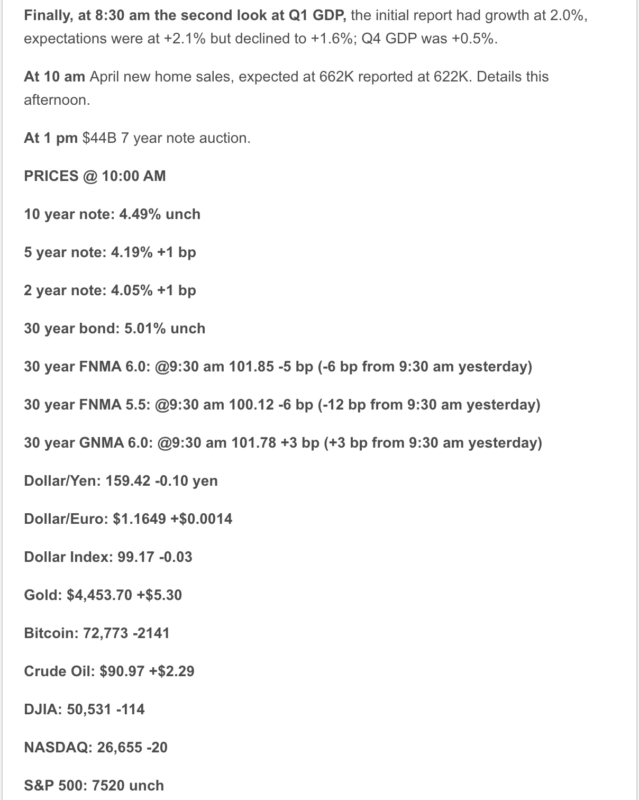
Bonds: The 10-year Treasury is hovering around 4.48%, slightly lower as markets digest hotter inflation, softer GDP, and a modest uptick in jobless claims. Bonds are trying to decide whether to fear inflation more or slowing growth more — the financial-market version of choosing between a root canal and a tax audit.
Mortgage Rates: Freddie Mac’s latest posted weekly survey shows the 30-year fixed at 6.51% and the 15-year fixed at 5.85% as of May 21. Daily Bankrate/WSJ tracking showed the 30-year fixed around 6.59% today.
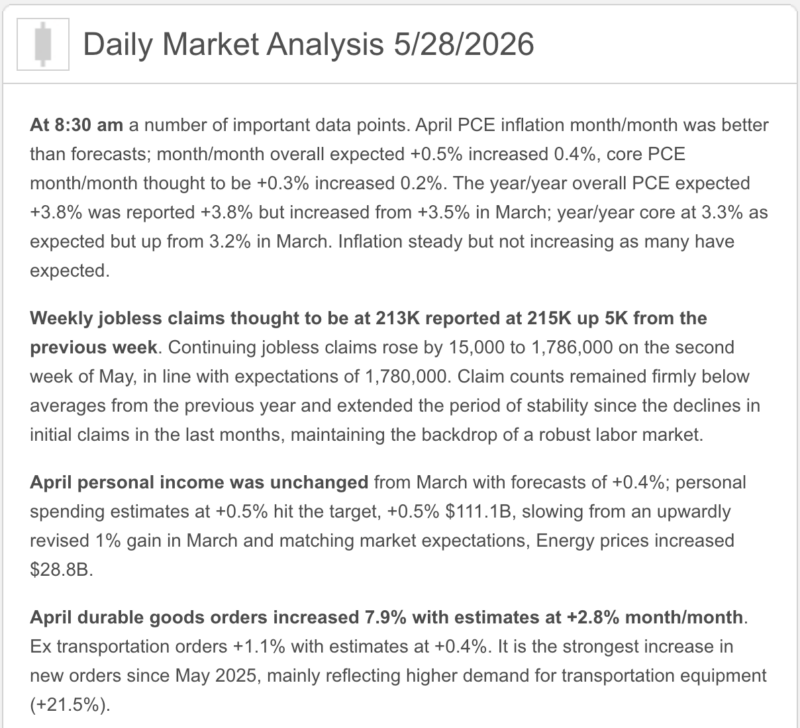
Inflation: April PCE inflation rose 3.8% year over year and 0.4% month over month. Core PCE rose 3.3% year over year and 0.2% monthly. That is still too warm for the Fed to start cutting with confidence.
Growth: Q1 GDP was revised down to a 1.6% annualized pace, from the prior 2.0% estimate, reflecting weaker economic momentum.
Labor: Initial jobless claims rose to 215,000, up 5,000 from the prior week, while layoffs remain relatively low overall.
Housing: New-home sales fell 6.2% in April to a 622,000 annualized pace, while new-home inventory rose to 489,000 units, equal to 9.4 months of supply.
1) Market Analysis – What Hit This Morning
Today’s market theme is hotter inflation, softer growth, and a Fed that still does not have a clean green light to cut.
The big number was PCE inflation, the Fed’s preferred inflation gauge. Headline PCE rose 3.8% annually, while core PCE rose 3.3% annually. The monthly numbers were less dramatic than March, but the annual trend is still too far above the Fed’s 2% target.
At the same time, GDP was revised lower to 1.6%, and jobless claims ticked up to 215,000. That combination creates a very uncomfortable policy backdrop: inflation is too high, but growth is losing steam.
Narrative you can use:
The economy is slowing, but inflation is still too sticky. That keeps the Fed cautious, keeps bonds volatile, and keeps mortgage rates elevated. This is not a panic market. It is a “structure the deal correctly or get punished by the payment” market.
2) Fed Watch
The Fed’s target range remains 3.50% to 3.75%. Fed Vice Chair Philip Jefferson said current policy is “well positioned” given upside inflation risks, and he did not prejudge the upcoming June 16–17 FOMC meeting.
New York Fed President John Williams also said policy is in the right place and described it as slightly restrictive, while acknowledging that persistent inflation could require tighter policy if conditions worsen.
Bottom line:
The Fed is not ready to cut. The market is increasingly debating hold vs. hike, not hold vs. cut. That is not the bedtime story buyers want, but it is the story bonds are reading right now.
3) Market Analysis – Where Mortgage Rates Actually Are
Freddie Mac’s latest weekly survey has the 30-year fixed at 6.51%, up from 6.36% the prior week, and the 15-year fixed at 5.85%, up from 5.71%. Freddie’s survey is weekly and can lag daily market movement.
Daily rate readings remain more sensitive. Bankrate/WSJ showed the average 30-year fixed around 6.59% today, slightly better than yesterday but still firmly in the mid-to-upper 6% range.
Practical read:
Rates are workable, but not forgiving. The right conversation is not simply, “What is the rate?” It is:
What is the payment? What credits are available? Is a buydown smart? Does an ARM make sense? What is the refinance path if the market improves?
4) Market Analysis – Housing Market Check
New-home sales dropped 6.2% in April to a 622,000 annualized pace and were down 11.3% year over year. Inventory increased to 489,000 new homes, pushing supply to 9.4 months, while the median new-home price rose 2.2% year over year to $422,500.
What this means:
Builders have more inventory pressure, buyers are payment-sensitive, and higher mortgage rates are clearly weighing on demand. That creates opportunity for buyers who are prepared, but it also means financing strategy matters more than ever.
For agents and buyers, this is where seller credits, builder incentives, permanent buydowns, temporary buydowns, and careful loan structure can do more than simply chasing a small price reduction.
5) Political Backdrop & Fed Independence
Geopolitics remain directly tied to rates. Energy disruption from the Iran conflict has fed inflation pressure, and Fed officials are now navigating inflation risks alongside a slowing-growth backdrop. Jefferson specifically noted that the U.S. is not fully insulated from global energy disruptions, even with domestic oil production.
The political pressure around Fed policy remains high, especially with inflation elevated and rate cuts unlikely in the near term. Markets are watching not just the data, but also Fed credibility, Treasury demand, oil prices, and whether inflation expectations stay anchored.
Translation:
Mortgage rates are not just following housing data. They are following inflation, oil, global conflict, Fed credibility, Treasury supply, and consumer resilience. Apparently, a mortgage rate sheet now needs a foreign policy minor.
6) Market Analysis – What This All Means for Rates Going Forward
| Scenario | What Needs to Happen | Likely Rate Impact |
| Best Case | Oil prices ease, PCE cools, labor softens gradually, Fed rhetoric calms | Mortgage rates drift lower |
| Base Case | Inflation stays sticky, growth slows modestly, Fed stays on hold | Rates stay choppy in the mid-to-upper 6s |
| Risk Case | Energy prices spike again, inflation expectations rise, Fed turns more hawkish | Rates push higher and reprice risk increases |
My read: base case is choppy, not catastrophic. The market is not pricing a housing collapse. It is pricing inflation risk, Fed caution, and a buyer pool that needs payment creativity.
7) Market Analysis – Practical Takeaways
For buyers:
Do not wait for the perfect rate. Perfect rates are like perfect inspection reports — beautiful, rare, and usually followed by fine print. Focus on payment, seller credits, buydowns, program fit, and long-term flexibility.
For homeowners:
Refinance decisions remain case-by-case. Cash-out, debt consolidation, HELOC alternatives, ARM reset planning, and future refinance strategy should all be reviewed individually.
For agents:
This is a payment strategy market. The strongest agents are not just saying, “rates are high.” They are showing buyers how credits, buydowns, price negotiation, and loan structure change the monthly payment.
8) Lock vs Float
Lock bias: If closing within 30 days, the borrower is payment-sensitive, or the file is tight on ratios, locking remains the cleaner recommendation.
Float bias: Floating can make sense only with more time, stronger borrower flexibility, and a defined trigger. Today’s data was mixed enough that floating blindly is not strategy — it is cardio with disclosures.
Today’s guidance:
Bias toward locking short-term closings. For longer timelines, floating may be reasonable only if the borrower understands the risk and has a clear ceiling for pain.
Stay safe and make today great!