


Good Thursday morning from your Hometown Lender. Let’s see if today’s market analysis is more good news!
Yesterday saw mortgage bonds drift lower as the afternoon progressed. Mortgage bonds did still end positive on the day, but were down about -10bps from when pricing came out, setting the stage for worse pricing on today’s rate sheets if bonds didn’t see some help this morning from the wholesale inflation data.
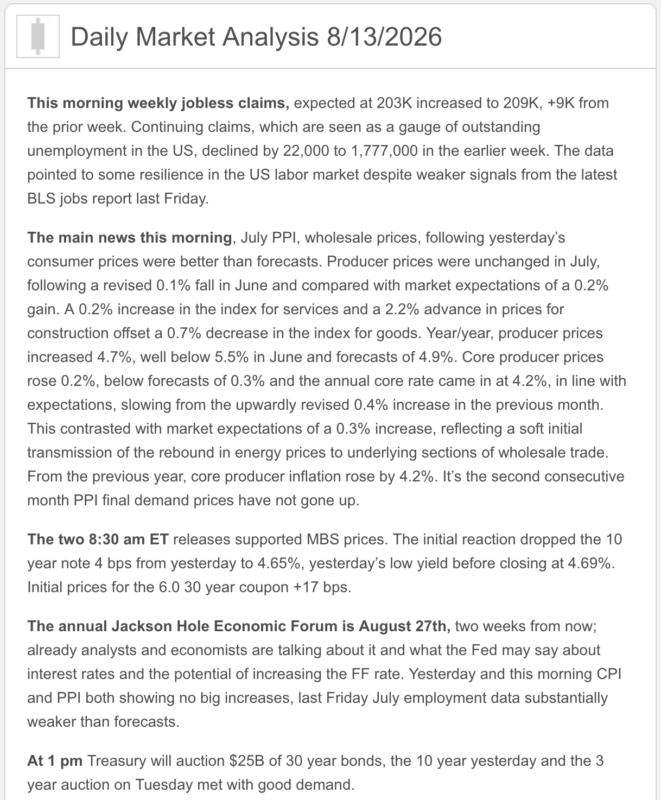
After yesterday’s consumer inflation data came in right on target with expectations, today’s wholesale inflation data (the PPI, Producer Price Index) for July came in flat, which was below the market analysis of a 0.2% increase. The core PPI rose 0.2%, but was below the 0.3% forecast. The annual numbers came in with a headline of 4.7% after coming in at 5.5% in June, and the core annual was 4.2%. Bonds liked the news, rallying a bit since the data adds evidence that inflation is continuing to cool and the Fed won’t need to hike rates in September to push it along.
So rates are better today, getting a boost from overnight trades as well as the wholesale inflation data. Oil prices had already fallen overnight, which helped bonds recover yesterday afternoon’s losses. Market expectations of a Fed rate hike have really fallen off for September, with markets now pricing in almost a 65% chance that rates will remain the same at the next meeting. A month ago, there was a 10% chance that the Fed would leave rates unchanged through the end of the year, and that has now jumped to over a 30% chance, according to Fed futures. Tomorrow brings retail sales numbers, and that could move markets.
Market Analysis – From a higher and better view:
Market Analysis – Quick Snapshot
- Inflation — Another Win: July PPI was unchanged (0.0%), better than the +0.2% expected, while annual producer inflation slowed to 4.7% from 5.5%. Goods prices fell 0.7%, although services rose 0.2%. Combined with yesterday’s cooler CPI, inflation has now given bonds two decent days in a row. Nobody scare it.
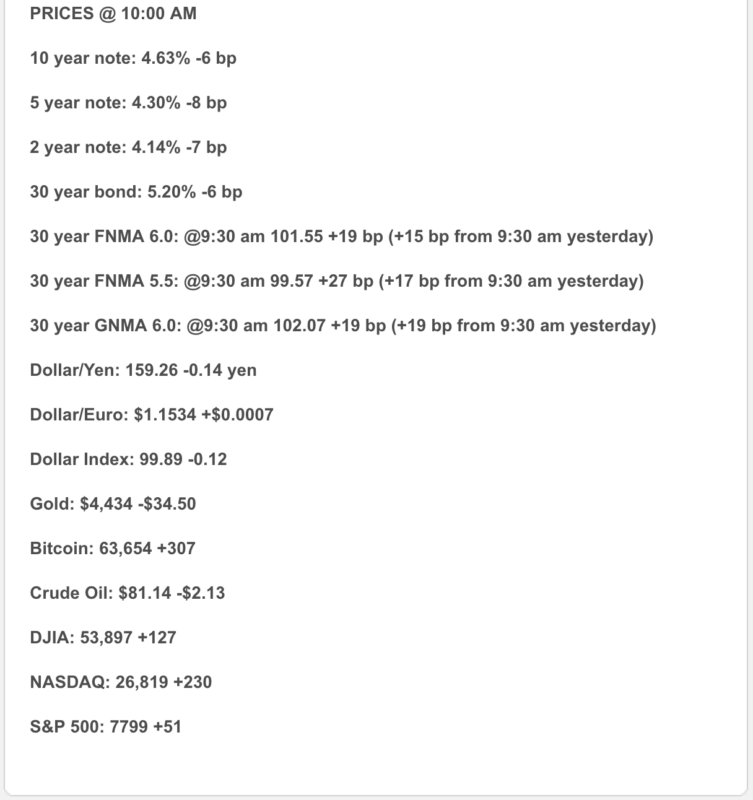
- 10-Year Treasury: The 10-year yield fell about 7 basis points to roughly 4.62% following the PPI report, providing some welcome support for mortgage pricing.
- Mortgage Rates: Freddie Mac’s new weekly survey has the 30-year fixed at 6.67%, down from 6.69%, and the 15-year at 5.96%, down from 6.01%. Faster-moving daily averages are around 6.74% for a 30-year fixed.
- Labor Market: Initial jobless claims rose modestly to 209,000, while continuing claims declined to 1.777 million. The labor market is clearly softer than earlier this year, but today’s claims data do not suggest a rapid deterioration.
- Fed Watch: After cooler CPI, softer PPI and July’s surprise job losses, markets now see roughly a two-thirds probability that the Fed holds rates steady in September. The Fed remains at 3.50%–3.75%.
- Oil & Geopolitics: Brent crude fell to roughly $86.70, with WTI near $81, as U.S. inventories increased and global demand forecasts were lowered. The U.S.–Iran/Hormuz situation remains unresolved, so energy inflation is still very much a wildcard.
- Politics & Fiscal Policy: July’s federal budget deficit hit a record $432 billion, bringing the fiscal-year-to-date deficit to $1.799 trillion—already exceeding the entire fiscal 2025 deficit with two months remaining. Large deficits matter to mortgage markets because persistent Treasury borrowing can keep longer-term yields elevated even when inflation improves.
Why It’s Happening
The market analysis has improved:
Cooler CPI + flat PPI + softer employment + lower oil = better environment for bonds.
But:
Large federal deficits + geopolitical risk + inflation still above target = long-term rates remain stubborn.
In plain English: The economic data is finally giving mortgage rates some help, but Washington and the bond supply department are making sure nobody gets too comfortable.
Market Analysis – What It Means for Housing
Freddie Mac’s 30-year average easing to 6.67% is welcome, but affordability remains the issue. July existing-home sales fell 1.7% to a 4.06 million annual pace, while the median price remained 2% higher than last year at $434,100.
This remains a structure-the-payment market:
Seller credits • Temporary/permanent buydowns • Builder incentives • Strategic ARM options • Debt consolidation • Future refinance planning
Buyers haven’t disappeared—they’ve become very good at market analysis.
Lock vs. Float
Closing within 15 days: Lock bias. Today’s bond rally provides an opportunity worth protecting.
15–30 days: Balanced. A cautious float is more defensible after CPI and PPI, but tomorrow’s retail sales and consumer-sentiment reports create additional event risk.
30+ days: Managed float bias has improved, provided the borrower has a clearly defined ceiling.
Today’s guidance:
Enjoy the improvement, but don’t get greedy. Better pricing today is real; tomorrow’s improvement is still hypothetical.
Stay safe and make today great!