


Good Friday morning from your Hometown Lender. We’ve got Friday’s market analysis after a wild week!
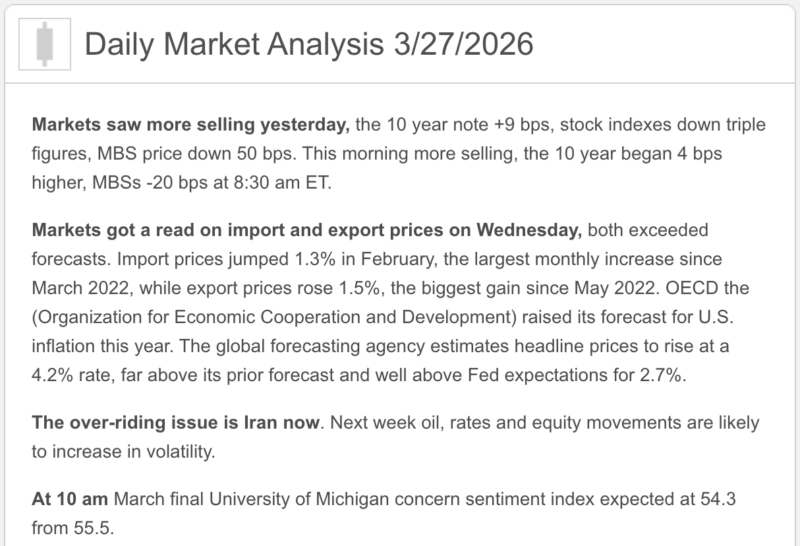
Yesterday saw bonds lose ground steadily through the day. It was ugly. Rate sheets will be worse this morning as bonds continue to sell off. Oil is up over $110 a barrel, and markets are likely to try to protect positions over the weekend, when President Trump tends to make big market moving announcements or actions.
Market Analysis – From a higher and better view:
🚀Market Analysis -Quick Snapshot
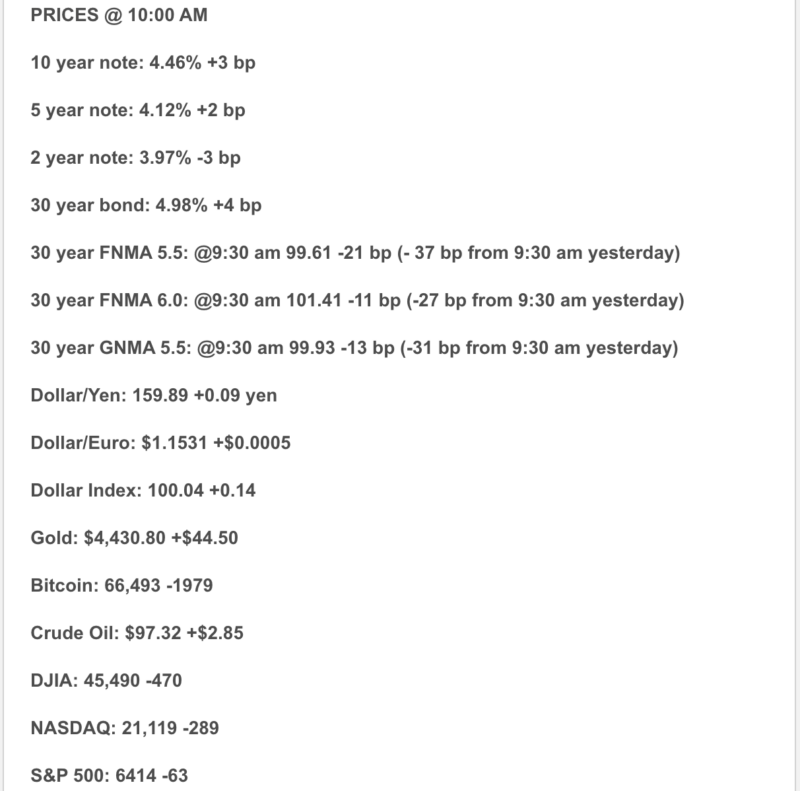
- Markets: In Reuters’ latest Friday snapshot, the 10-year Treasury yield was 4.44%, Brent crude was $110.55, WTI was $97.84, the S&P 500 was down 0.88%, and the Nasdaq was down 1.33%.
- Fed: The Fed held the target range at 3.50% to 3.75% on March 18, and its statement said economic activity is still expanding at a solid pace, job gains have remained low, and inflation remains somewhat elevated.
- Inflation: February CPI was 2.4% headline and 2.5% core year over year. The latest PCE reading, for January, was 2.8% headline and 3.1% core. Import prices then added another inflation wrinkle, jumping 1.3% in February, the biggest monthly increase since March 2022.
- Labor: The latest payroll report showed nonfarm employment down 92,000 in February, while the unemployment rate held at 4.4%.
- Mortgage rates: Freddie Mac shows the average 30-year fixed at 6.38% and 15-year fixed at 5.75% as of March 26. The MBA survey showed the average 30-year contract rate at 6.43% for the week ended March 20.
- Housing: Existing home sales were 4.09 million in February, pending home sales rose 1.8%, new home sales fell to 587,000 in January, and builder sentiment was just 38, with 37% of builders cutting prices and 64% using incentives in March.
The big takeaway
Today’s calendar was lighter than normal because February Personal Income and Outlays is no longer on today’s schedule and February durable goods was pushed to April 7, so the market is trading a simpler theme: higher oil, higher yields, weaker sentiment, and Fed officials who sound much more “not yet” than “cut away.”
🎯Market Analysis -What Hit This Morning?
The freshest economic headline this morning was final March consumer sentiment, which fell to 53.3 from 56.6 in February. More importantly for rates, one-year inflation expectations rose to 3.8%, which tells the Fed exactly what it does not want to hear.
At the same time, markets are still trading the Middle East more than domestic macro. Oil rose again Friday as investors doubted a near-term ceasefire, while stocks fell and Treasury yields pushed higher. In plain English: even without a major U.S. report today, the bond market still had plenty to worry about.
Translation:
Today is another reminder that mortgage rates are not just watching CPI and payrolls. Right now they are also glued to oil, geopolitics, and whether inflation psychology starts getting sticky again.
🏦 Fed Watch
The Fed itself has not changed policy since March 18, but the tone from officials this week has been consistently cautious. Lisa Cook said the balance of risks has shifted toward inflation because of the Iran war. Philip Jefferson said sustained higher energy prices could worsen both inflation and spending. Michael Barr warned the Fed needs to stay vigilant against rising inflation expectations. Thomas Barkin said the economic outlook is again obscured by “fog.”
That matters because the market has repriced hard. Reuters reported earlier this week that futures markets had moved from expecting at least one cut this year before the war to expecting the Fed to hold off on cuts, while this week’s Fed commentary has leaned into that higher-for-longer message.
Plain English:
The Fed is not looking for an excuse to help rates right now. It is looking for proof that inflation will cool again, and higher energy prices are making that proof harder to find.
📈Market Analysis -Where Mortgage Rates Actually Are
This is where market chatter turns into real monthly payments.
- Freddie Mac weekly average: 6.38% for a 30-year fixed, 5.75% for a 15-year fixed.
- MBA application survey: 6.43% average contract rate for a 30-year fixed for the week ended March 20.
- Since the Iran conflict escalated, Reuters says mortgage rates have climbed 34 basis points in three weeks, while the 10-year Treasury yield rose from 3.96% on February 27 to 4.39% by Tuesday.
- Mortgage demand is already feeling it: the MBA applications index fell 10.5%, with refis down 14.6% and purchase apps down 5.4% last week.
Real-world takeaway:
Rates had been improving earlier this month, but that improvement got mugged in a dark alley by oil, Treasury yields, and inflation fear. Not ideal. Very on-brand for 2026, apparently.
🏠Market Analysis -Housing Market Check
The good news
- Existing-home sales rose 1.7% in February to a 4.09 million annual pace.
- Pending home sales rose 1.8% in February, with gains in the South and West.
- Existing-home inventory rose to 1.29 million units, equal to 3.8 months’ supply.
The not-as-fun news
- New home sales in January dropped 17.6% to 587,000, with supply rising to 476,000 homes for sale.
- Builder sentiment is still weak at 38, well below the 50 break-even line.
- Builders are still leaning on incentives: 37% cut prices in March, the average cut stayed at 6%, and 64% used incentives.
What that means
Housing is still moving, but it is very payment-sensitive. Lower rates brought some buyers back into the water. The latest rate backup is exactly the kind of thing that can make them paddle back to shore with their shoes still on.
🌍Market Analysis -Political + Global Market Backdrop
The biggest political and geopolitical story remains Iran. Reuters reports that Iran’s response to the U.S. peace proposal is expected Friday, while Trump has paused threatened strikes on Iranian energy plants until April 6. Markets have taken some comfort from diplomacy headlines, but oil is still elevated because traders clearly do not think this is wrapped up with a neat little bow yet.
Trade policy is still an inflation wildcard too. Reuters reported the administration’s temporary 10% global tariff took effect in February, and officials have said that some countries could face rates of 15% or higher. That means the market is dealing with both an energy shock and ongoing trade-cost uncertainty at the same time.
Why that matters
Mortgage rates do not need every risk to become reality. They just need enough inflation risk to keep bond buyers nervous, and right now they have plenty to work with.
🔮 What This Means for Rates Going Forward
Base Case
My base case is that rates stay choppy to slightly elevated near term. Elevated oil, higher import prices, shakier sentiment, and hawkish Fed rhetoric are all working against a clean mortgage rally.
Best Case
The bullish case for rates is that diplomacy actually sticks, oil backs down meaningfully, and the next round of inflation data behaves. That would give Treasury yields room to settle and mortgage pricing room to improve again.
Worst Case
The bearish case is straightforward: oil stays high, inflation expectations keep rising, and the Fed spends the next few weeks sounding even less patient. That would keep upward pressure on the 10-year and on mortgage rates.
Bottom line:
This still looks like a market where one good day for rates can get erased by one ugly headline before lunch.
🧠Market Analysis -Practical Takeaways
For buyers:
This is still a strategy market, not a perfection market. If the home works and the payment structure works, waiting for a fairy-tale straight-line drop in rates may just mean shopping later with more frustration and the same group text.
For agents:
Spring demand is there, but it is fragile. This is a market for payment conversations, seller concessions, buydowns, and realistic expectations—not generic “the market is hot” energy.
For homeowners thinking about refinancing:
This week is another reminder that rate windows can close quickly. When the market gives a borrower a gift, it usually does not wrap it first.
🔒 Lock vs Float
Lock if:
- closing is within 30 days
- the borrower is payment-sensitive
- the file is tight on qualifying
- the deal cannot tolerate a fresh round of volatility
That is especially true with the 10-year elevated, oil still jumpy, and Fed officials sounding cautious.
Float cautiously if:
- the borrower has more time
- the file is strong
- everyone understands the risk
- the borrower can tolerate some short-term backup in pricing
That is a measured-risk call, not a blind-optimism call.
Simple rule:
If a worse rate creates a real problem, lock. If the borrower has flexibility and time, a cautious float can still make sense.
Stay safe and make today great!