


Good Wednesday morning from your Hometown Lender. Here’s today’s pre-FOMC market analysis!
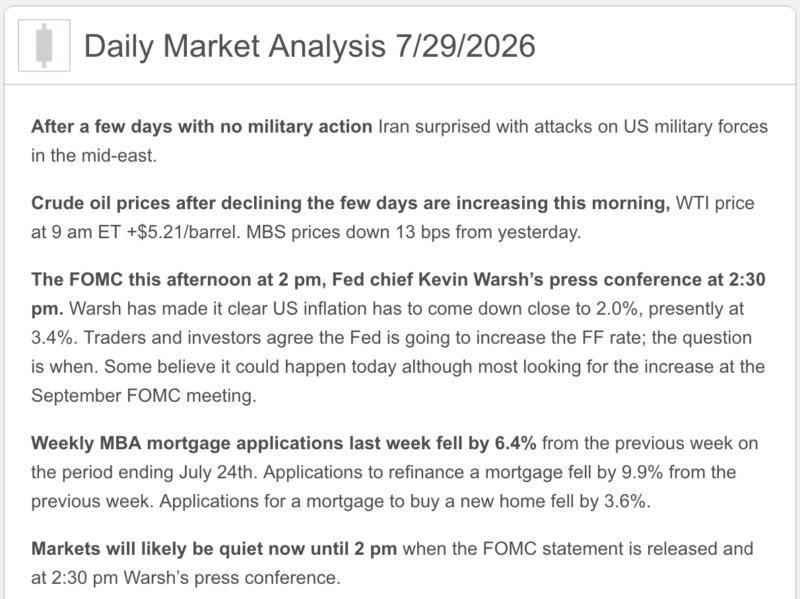
Yesterday saw mortgage bonds improve through the morning and ending the day with solid gains. As the day ended yesterday, it looked like we might be in a good position heading into today’s Fed meeting to see rate sheets continue to improve. Unfortunately, bonds are off to a weaker start this morning as oil prices jump after a flare up in attacks between the U.S. and Iran in the Middle East.
Apparently, if the media is to be believed, Iran surprised us with a missile attack on U.S. forces in Jordan, basically thumbing their nose at President Trump and showing they aren’t worried about retaliation and aren’t as interested in a deal as was reported. As would be expected, the president said that Iran “is going to get a beating” and that “we’ll be hitting them hard.”
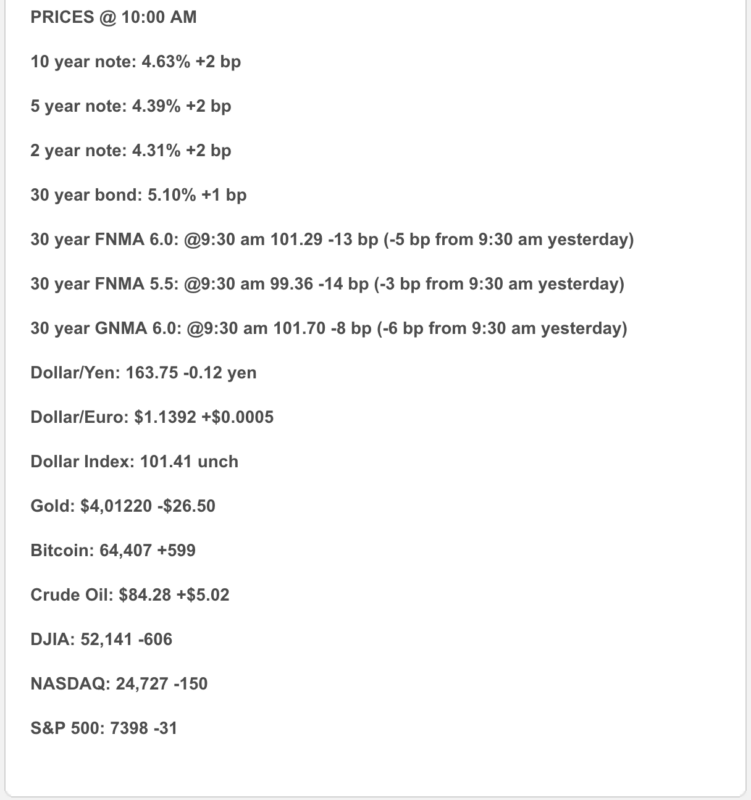
Brent crude jumped from $84 a barrel yesterday to about $90 a barrel this morning, and although bonds are in the red (negative) on the day they aren’t nearly as bad as we’d expect. I would say that bonds have used up the cushion that was baked in for the Fed meeting today, the one that I thought was going to help open the door for a nice relief rally that would have brought better pricing.
Not only does today have potential volatility due to the attacks in the Middle East but today is also the conclusion of this month’s Fed meeting. The Fed will announce any rate movements and release its policy statement shortly. Expect very little guidance in the statement, reflecting new Fed Chair Warsh’s belief that the Fed should not be providing forward guidance to markets.
Warsh will hold his press conference at 11:30am, and it is likely markets will try to read between the lines to nail down if the Fed plans on hiking it’s policy rate next meeting in September. We likely will see bonds react through the late afternoon.
Market Analysis – From a higher and better view:
- 10-Year Treasury: The 10-year yield is near 4.64%, up roughly three basis points as oil prices surge and investors prepare for today’s Federal Reserve decision. Bond traders have replaced their morning coffee with antacids.
- Mortgage Rates: National daily averages are approximately 6.75% for a 30-year fixed and 6.10% for a 15-year fixed—slightly improved from yesterday but still elevated.
- Fed Watch: The Fed announces its decision at 11:00 a.m. Pacific. Markets assign roughly a 65% probability of holding the federal-funds range at 3.50%–3.75% and a 35% chance of a quarter-point increase. The statement’s tone may matter even more than today’s decision.
- Inflation & Tomorrow’s Data: June CPI slowed to 3.5% annually, but the Fed’s preferred PCE measure was still 4.1% in May. Tomorrow morning brings both the first estimate of second-quarter GDP and the June PCE inflation report, creating another significant test for bonds and mortgage pricing.
- Oil & Geopolitics: Brent crude jumped roughly 7% to $90.25, while WTI climbed to approximately $84.65, following renewed Middle East airstrikes, threats to shipping routes and a larger-than-expected decline in U.S. oil inventories. Higher oil means higher inflation risk—and bond investors noticed immediately.
- Housing: The latest FHFA report showed home prices increased 0.3% in May and 2.2% year over year. Appreciation is slowing, but national values remain positive despite elevated mortgage rates.
- Politics & Trade: New U.S. tariffs of 10%–12.5% on imports from 60 trading partners remain another potential source of inflation. Markets are simultaneously balancing tariff policy, political pressure for lower rates and the Fed’s responsibility to control prices.
Market Analysis – Why It’s Happening
Markets are confronting an uncomfortable combination:
Cooling consumer inflation + renewed oil shock + new tariffs + a highly uncertain Fed decision.
In plain English: Inflation had begun behaving better, but oil and geopolitics just handed it another espresso.
Market Analysis –What It Means
A Fed hold would not automatically lower mortgage rates. Bonds will focus on whether Chair Kevin Warsh signals a likely September increase and how concerned policymakers are about oil, tariffs and persistent service-sector inflation.
Tomorrow’s GDP and PCE reports could extend—or reverse—whatever move follows today’s announcement.
Lock vs. Float
- Closing within 30 days: Lock bias. With the Fed today and GDP/PCE tomorrow, there is substantial event risk packed into the next 24 hours.
- Closing beyond 30 days: A carefully managed float may be reasonable, but only with a defined ceiling and the ability to lock quickly.
Today’s guidance:
Protect good pricing. This is not the day to confuse hope with strategy.
Stay safe and make today great!